The Swabian Alb is often underestimated. Yet this low mountain range has it all, in the truest sense of the word. The "brittle beauty" stretches across the state like a loaf of bread, riddled with holes like a Swiss cheese. Formerly derided as "Swabian Siberia", the Alb has long since become a holiday paradise for the curious.
The hearts of explorers automatically beat faster here. Do you know, for example, the Swabian Venus, which enchants archaeologists from all over the world? Have you heard of the mountain that secretly slid down? Do you know where you can dance exuberantly on the volcano? No? Then follow us: we'll tell you 15 fascinating spots you should visit in the Swabian Alb.
1. the Ofterdingen snail pavement: secretly petrified
Watch out or you'll walk right past it! The small village of Ofterdingen has a well-kept secret: hundreds of impressively large fossils have come to light in the stone streambed of the small Steinlach river: the "Ofterdinger Schneckenpflaster".
Strictly speaking, of course, these are not snails, but oyster shells and ammonites of the genus Arietites - the extinct relatives of the octopus.
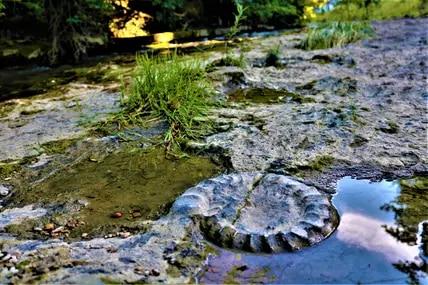
Hidden and fossilised: Who will discover the snail patch in Oferdingen?
© Source: Alexandra Brucker
With their diameters of a proud 80 centimetres, the would-be snails attain giant forms and are especially easy to see at low tide. Altogether, the ammonite patch is about 100 metres long and four metres wide. Although the geotope is strictly protected as a natural monument, you can even walk on it. Well, how does it feel to walk around on 190 million year old slabs of rock?
2. The Lemberg Tower and the "Region of Ten Thousands
If you want to get to the top of the Swabian Alb, you can't miss its southwestern part. In the Donaubergland region, the ten highest mountains in the Alb are spread over an area of just 20 square kilometres. But don't worry, the "ten thousands" can be mastered without climbing ropes and crampons.
An absolute must-do: climb the Lemberg(turm) and enjoy the view over the whole of Baden-Württemberg from the "roof of the Alb". Admittedly, the Lemberg is not the Zugspitze, but with its proud 1015 metres it is the highest elevation in the Swabian Alb.

In the Swabian Alb, it is the highest far and wide: The Lemberg(turm).
© Source: Alexandra Brucker
Are you free from giddiness? Then let's get you up there: at the top of the steel observation tower you will be rewarded with a magnificent panoramic view. On the "roof of the Alb" you can see not only over the towns and villages of the Alb foothills, but also as far as the heights of the Black Forest and, on some days, even as far as the Swiss Alps.
3. the Wental: where women turn into rocks
Sphinx, hippopotamus, Bischofsmütze and Hirschfelsen are the names of the free-standing dolomite rocks that stand near Bartholmä in the Wental. You are in a typical dry valley in the Swabian Alb. This unique natural landscape developed from the riverbed of the Wedel stream. After the Jurassic Sea receded some 150 million years ago, the water eroded deeper and deeper into the rock until it completely seeped away.
So even today, despite the steep valley walls in the Wental, there is no longer a stream to be seen. All that remains are its bizarrely shaped, rustic stone witnesses. The most famous rock in the valley is the so-called Wentalweible, which is enthroned on the summit cross. Legend has it that a miserly shopkeeper who cheated her customers was struck by lightning during a thunderstorm and petrified.

Stone hippos graze in the Wental valley in the Swabian Alb.
© Source: imago images/imagebroker
On 1 December, you should prick up your ears: On this night you can supposedly still hear her howl as she regrets her heartless deeds in the broadest Swabian. The Felsenmeer in the Wental is especially recommended for families, as the flat route through the valley is also well suited for prams.
4. The Mössingen Landslide: Secretly Demolished
At the Hirschkopf near Mössingen you can experience geological history in fast motion. On 12 April 1983, the largest and most spectacular landslide in the Swabian Alb to date occurred on the Alb ridge. Within a few hours, four million tonnes of earth and debris slid down. Where there had previously been dense forest, a huge gravel desert with metre-high mounds of rubble and uprooted trees had emerged.
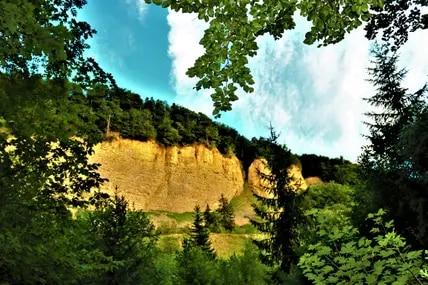
It was a geological sensation: on 12 April 1983, the mountain at Hirschkopf slid down.
© Source: Alexandra Brucker
A tremendous natural event for which, unbelievably, there were no eye or ear witnesses. Secretly, hidden by the fog, the largest landslide in Baden-Württemberg for over 100 years had occurred. Today you can see how the destroyed area has been repopulated. Over the years, the "primeval landscape" has developed into a refuge for many animal and plant species.
The area is now a nature reserve, national geotope and part of the Unesco Geopark. Nowadays you can enter the area on signposted paths. But beware: the area has not yet come to a complete standstill. Hiking in the Swabian Alb is something for the brave! Do you dare?
5. Park Inzigkofen: With Princess Amalie through the Green Salon
Now it's getting romantic. The Fürstliche Park Inzigkofen to the west of Sigmaringen offers the perfect backdrop for a wild walk. It doesn't get any greener than this: rocky gates, grottos, spectacular bridges and repeated views of the sparkling Danube - on a tour through the Green Salon of Inzigkofen we experience pure nature.
Inzigkofen was the favourite residence of the Sigmaringen princess Amalie Zephyrine. When she hosted tea parties in her park, guests even came from Munich and Karlsruhe. For here in the Danube valley, a few kilometres from Sigmaringen, the noblewoman had created an extraordinary garden complex from 1815 onwards.

Stroll through the Green Salon: Park Inzigkofen delights with bridges, rock gates and the sparkling Danube.
© Source: Alexandra Brucker
To this day, narrow paths lead through avenues of linden trees and steep slopes to vantage points such as the Amalienfelsen or the Känzele, from which you always get new perspectives on the river landscape and the Danube valley. One highlight of the complex was only built after the death of the princess: the Devil's Bridge swings spectacularly between two rocky slopes over a 20-metre-deep abyss. Pleasure strolls permitted!
6. The Ipf: Mysterious Celtic Stronghold
You can't miss its hump from afar: the Ipf. The witness mountain of the White Jura towers majestically and mysteriously over the landscape around Bopfingen. The conical mountain is 668 metres high and forms the eastern foothills of the Swabian Alb. Archaeological excavations indicate that one of the largest Celtic princely seats north of the Alps was located on the Ipf.
Here, researchers discovered "Mediterranean imported goods", including Greek amphorae, a coin and pottery from Athens. The ramparts of the princely fortifications are still clearly visible on the eastern flank. The climb to the summit plateau is also recommended via the flat eastern ridge.

Mysterious: The Celtic stronghold Ipf arches its hump.
© Source: imago images/McPHOTO / THI
From the top, there is an impressive view over the meteorite crater Nördlinger Ries and the historical landscape, which is characterised by traditionally cultivated rough pastures and juniper heaths. With this sweeping view, you'll almost feel like a Celtic prince or princess.
7. The Schopfloch Moor: Dancing on the Volcano
Anyone who gets to know the Swabian Alb on excursions will quickly notice: In contrast to the Black Forest or the Alpine foothills, there is very little water here. In the crevices of the Jurassic limestone, the water easily seeps away and quickly disappears underground.
This circumstance makes the "Schopflocher Moor" near Lenningen a special natural treasure. It is the only raised bog on the water-scarce Alb plateau. Walkers can cross the moor on a wooden footbridge and admire its special features. Gnarled bog birches and rowan trees stand here among blueberry bushes, moor grass, sedges and rushes. Everywhere it chirps and hums.

Favourite excursion destination Schopflocher Moor: Why doesn't the water seep away here?
© Source: imago images/blickwinkel
But why was the water able to collect here in the first place? The answer to the riddle is under your feet: the moor lies on a 17-million-year-old volcanic vent.
8. The Swabian Hanami: Reveling in the Orchard Paradise
Hanami, "looking at blossoms", is a Japanese tradition. But why fly to Japan when you can also admire the cherry blossom in the Swabian Alb? Since 2011, the cherry blossom festivals have also been celebrated in the orchard country between the Alb, Neckar and Rems. In spring, if you look down from one of the numerous vantage points on the Alb ridge into the foothills of the Alb, you will see the largest contiguous orchard in Europe.

Apple blossom or cherry blossom? In any case: Swabian Hanami!
© Source: Alexandra Brucker
Every year, around 1.5 million fruit trees blossom on 26,000 hectares. This masterpiece in the form of a tree is ideal for a hike, including a picnic in the rain of blossoms. But it is not only in spring that the typical meadow orchards have their charm. In summer they are full of cherries, mirabelles and plums, and in autumn they offer an almost endless variety of apples and pears.
An insider's tip: On the Dettingen Cherry Trail you can taste different types of cherries on the blue-marked trees at harvest time. Let's go to the Swabian Hanami!
9. The Prehistoric Museum in Holzmaden: "Jurassic Park" in Ländle
On an ice-cold winter's day, it's hard to imagine that 180 million years ago a tropically warm sea sloshed over the Swabian Alb. Today, you can admire the remains of the animals and plants that swam in it as impressive fossils in the Hauff Prehistoric Museum in Holzmaden.
Germany's largest private natural history museum houses the best-preserved and most spectacular finds discovered in Holzmaden, Ohmden and the surrounding area over the last 150 years. The exhibits include an ichthyosaur with fossil skin and musculature, a complete pterosaur, various marine crocodiles from the Jurassic period as well as numerous well-preserved rare fish and a variety of ammonites, belemnites and crustaceans. The main exhibit, covering more than 100 square metres, is the world's largest colony of crinoids: hundreds of flowers entwine around a twelve-metre-long driftwood.

A celebrity in the Prehistoric World Museum in Holzmaden: The ichthyosaur.
© Source: imago images/Horst Rudel
If the sight of such great fossil beauty whets your appetite for more, you can get active yourself 2.5 kilometres away from the Prehistoric World Museum. In the Kromer slate quarry in Ohmden, researchers of all ages can go fossil hunting from March to November.
10. The Caves of the Swabian Alb: A Heart of Stone
Why not be down for a change? Sure: the Swabian Alb is a dream destination for anyone who likes to explore caves and underground excursions. Incessantly, the water carries the dissolved limestone away underground. The result: with its 2700 caves, the region is riddled with holes like a Swiss cheese. The Bear Cave lives up to its name.
Nowhere else in the Swabian Alb have more well-preserved cave bear remains been found. The skeleton of such a primeval giant greets you right at the edge of the path. The Nebelhöhle, on the other hand, is considered one of the most beautiful cavities underground in the Swabian Alb because of its dripstones.

There are 2700 caves in the Swabian Alb. The Bärenhöhle is one of the best known.
© Source: imago images/Arnulf Hettrich
The deepest cave is the Laichinger Tiefenhöhle: with its fossilised reef, enormous shafts and huge halls, it is an extraordinary geotope worth seeing and reaches 86 metres down into the belly of the earth. The tour of the Wimsen Cave may only take ten minutes, but it is an experience you won't find anywhere else in Germany. On a guided boat tour, you can sail around 70 metres into the water cave.
11. The Great Lauter Valley: A Natural Wonder Rich in Castles
The valley with the most castles in Germany is a magnet for all outdoor fans who like cycling, hiking, riding or canoeing. In 2019, the Große Lauter was voted a natural wonder. On its way to the Danube, the river meanders through meadows and floodplains, past sloe hedges and juniper heaths, rock formations, small rapids and a whole 18 medieval castles and ruins.
From the spring pool in the courtyard of the former Offenhausen monastery to its mouth in the Danube, you'll find everything your hiking, cycling or paddling heart desires here. A detour to Marbach, Germany's oldest stud farm, will delight horse girls and boys in particular.

There are 2700 caves in the Swabian Alb. The Bärenhöhle is one of the best known.
© Source: Alexandra Brucker
You belong to the "water" team? Off to the river with you: the Great Lauter Valley is also worth a trip from the swan's perspective. Between Buttenhausen and Indelhausen, water rats can take a canoe trip.
12. Hohenneuffen Castle Ruin: Please keep an overview
Castles, castles, castles: the Swabian Alb is literally paved with defiant structures on mountain ridges. Hohenzollern Castle is of course the most prominent example, but certainly not the only one. Many castles in the Swabian Alb can be visited and offer a medieval programme for children; in others, such as Katzenstein Castle, medieval fans can even spend the night.
It is worth climbing the Hohenneuffen fortress. It has towered over the town since 1140, on a 743-metre-high rock massif. No enemy has ever been able to defeat its mighty bulwark. Nowadays you don't have to be afraid, visitors are welcome.

In the past, no one could conquer the fortress, but today guests are welcome at the imposing Hohenneuffen castle ruins.
© Source: imago images/McPHOTO
Once you've made the 20-minute climb from the hikers' car park, you'll be rewarded with a breathtaking distant view all the way to the Black Forest High Road, weather permitting. The so-called blue wall of the Swabian Alb is particularly visible here. Wine connoisseurs should not miss the famous "Täleswein", which is pressed in the adjacent Neuffener Tal valley.
13. The two Urach waterfalls: Big brother and little brother
A walk along the Brühlbach stream to the Urach waterfall, the highest waterfall in the Swabian Alb, is not an insider tip, but always a nature experience - no matter what time of year. From the hikers' car park, a footpath leads through the wildly romantic floodplain landscape of the Brühlbach valley to the Urach waterfall.
A steep staircase leads directly along the waterfall up to the high plateau and provides hikers with ever new impressions. The water plunges almost 40 metres into the depths. But how about extending the walk a little? With a little more time in your luggage, you should definitely hike along the "Wasserfallsteig" to the more hidden Gütersteiner waterfall.

A celebrity: the Urach waterfall. But do you also know its little brother, the Gütersteiner Waterfall?
© Source: Alexandra Brucker
The little brother of the Urach Waterfall is less famous, but all the more romantic. In many small cascades, its water falls into a enclosed pond. Above this pond is a small chapel that commemorates the Güterstein Monastery, which stood on this spot until 1560.
14. The Steiff Museum: A Cuddly Affair
A museum full of animals to love and pet? That's what you'll find in Giengen an der Brenz. It was here that Margarete Steiff made her first teddy bear a good 130 years ago and made the little town in the Swabian Alb the capital of soft toys.
In the Steiff Museum, visitors can experience on three levels how an original Steiff animal is made. The highlight for children is certainly the world's largest walk-in petting zoo. More than 2000 cuddly animals have found a home on a total area of 2400 square metres.

Welcome to the capital of teddy bears: The Steiff Museum.
© Source: imago images/Volker Preußer
If you want, you can cuddle gorillas, ride tigers, explore jungle landscapes or slide straight down the world's longest plush slide in the shape of a gigantic snake into the jungle. The Steiff Museum is the perfect destination for young and old, with the motto: On your marks, cuddle up, go!
15. The lift test tower in Rottweil: A giant on the Alb
If you're driving from Stuttgart on the motorway, you'll see Rottweil's Aufzugstestturm from afar. Please raise your hand: Who doesn't think of "Lord of the Rings" and Saruman's Tower at the sight of this grey giant?
The modern landmark of Baden-Württemberg's oldest city has won numerous architecture, engineering and design awards, weighs as much as 8,000 elephants, its staircase consists of almost 1,500 steps. The futuristic giant not only serves to test lift innovations, but is also Germany's highest visitor platform.

After only 30 seconds, it offers a perfect view of two low mountain ranges: the lift test tower in Rottweil.
© Source: Alexandra Brucker
In 30 seconds, its glass lift catapults you 246 metres into the air. The surroundings blur, the landscape flies by. High-flyers are rewarded by a breathtaking panoramic view. And because Rottweil is conveniently located right in the middle between the Black Forest and the Swabian Alb, you can now view the heights of both low mountain ranges.